product designer
Vision · strategy
UX · visual design
Kidlio is an AI-guided platform that helps children turn a personal goal into a small business, building money skills through planning, pitching, selling, and reflection with parent approval and support at key moments.
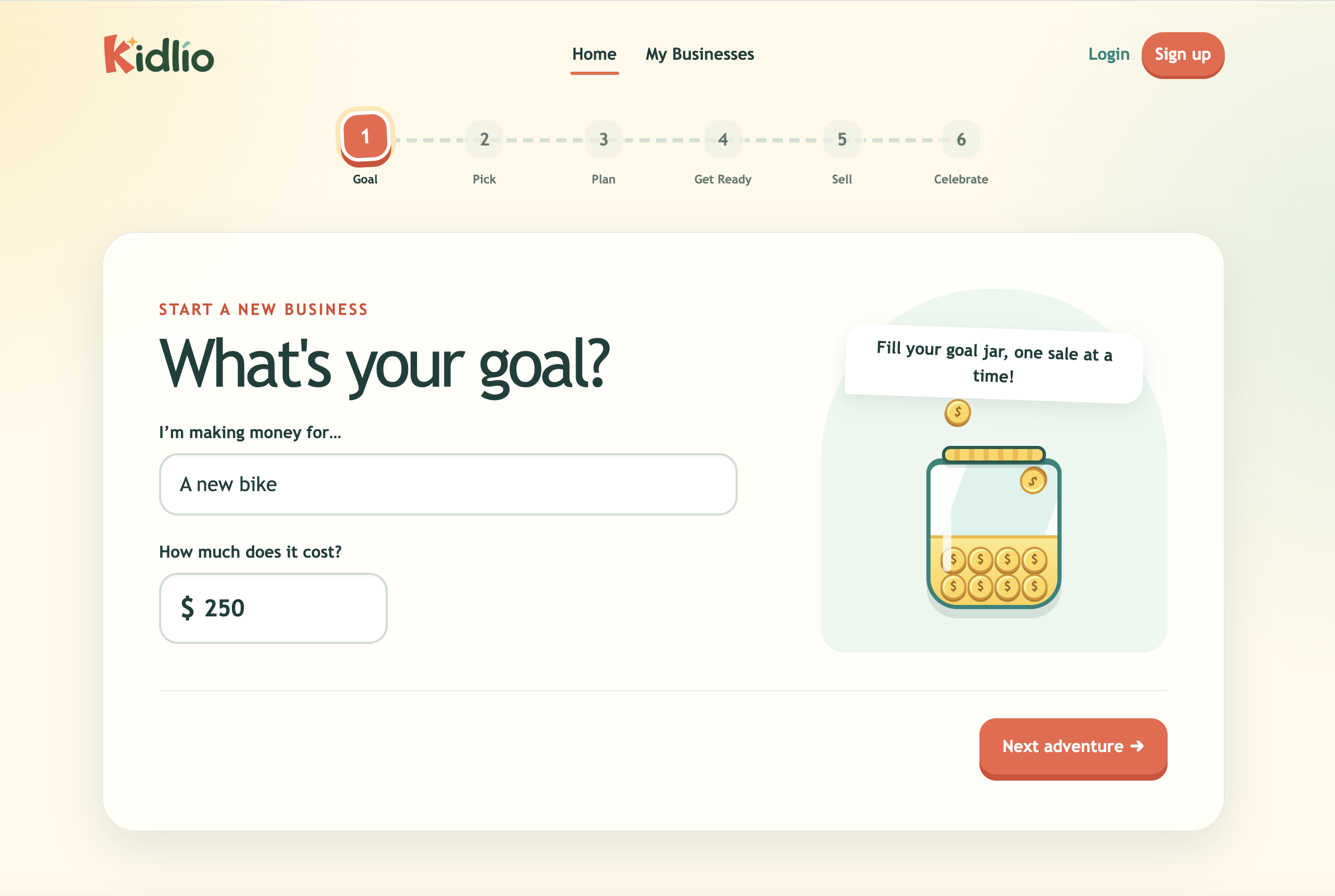 $$
Kidlio guides a child through starting and running a first small business. The child owns the choices and real-world action; the parent supports the parts that require time, money, preparation, or safety.
Vision · strategy
UX · visual design
Designed and built with Codex
Responsive web
Qualitative feedback
Design iterations
Child agency
Parent oversight
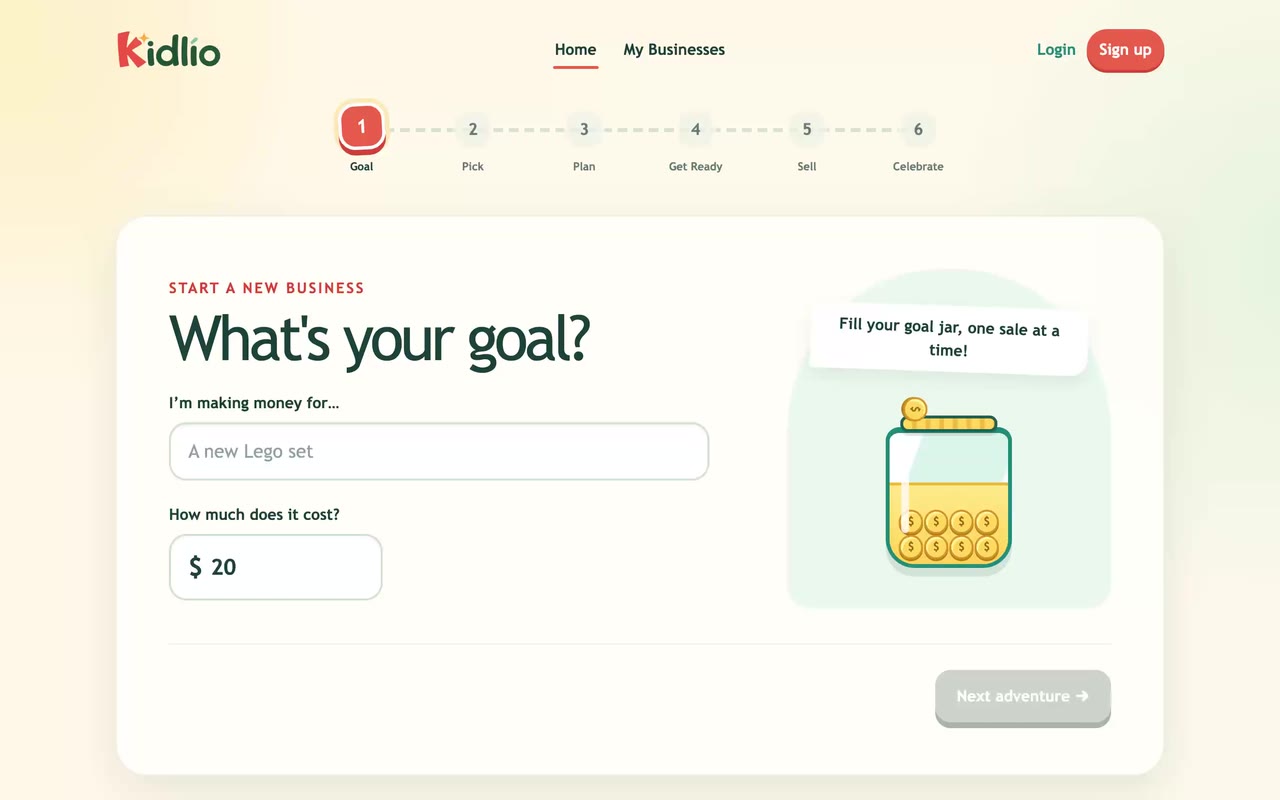
Choose a wish and amount.
Choose a business and sourcing path.
Set price, costs, and estimated profit.
Review, present, and practice.
Record sales and “no thanks.”
See revenue, margin, and reflect.
For children ages 7–12 and their parents.
Choose a goal and business, understand the plan, prepare, sell, and reflect without having to assemble the entire workflow alone.
Understand what the child needs, review requests, approve purchases, and support preparation and safety without taking over every decision.
Children get a motivating record of their businesses and milestones. Parents get the visibility, approvals, and family controls needed to support them.
Put choosing, planning, practicing, selling, progress, and reflection in one visible place.
Turn scattered preparation, approvals, tracking, and coaching into a guided flow.
Use AI for setup and calculations while preserving child decisions and parent control.
He wanted to know how to earn the money himself. That personal goal gave him a reason to start a business.
We tested recipes, prepared a batch, and took his first business into the real world.
I manually planned, sourced, prepared, supported selling, tracked results, and led reflection. It was exhausting, and he had no single place to see progress or what came next.
Parents liked the idea and imagined lemonade, cupcakes, or another first business with their own children.
Kidlio helped me prepare my seven-year-old with confidence. He used the pitch deck and guided question prompts before his next two selling days.
He could follow the overall workflow with support.
I helped him choose supplies and decide what was worth spending.
Busy selling moments required occasional help recording sales accurately.
The prompts supported conversations about wins, rejection, and what to try next.
Parent involvement shifts from everything, to occasional assistance, to reflection and coaching.
Kidlio remembers, calculates, recommends, and drafts across the journey. Children still make the choices and take real-world action; parents join where approval, safety, and coaching matter.
Recommend · calculate · organize · draft
Choose · review · practice · act
Refine · approve · prepare · coach
Recommends products or ingredients, quantities, costs, prices, and expected margin.
Builds an editable shopping list the child can send for parent review and approval.
Generates a deck covering the goal, purchase ask, spend, pricing, and margin, plus customer-question prompts.
Tracks revenue, actual margin, and goal progress, then helps the family reflect on what happened.
The trust boundary: AI never sends a request, approves a purchase, or takes real-world action for the family.
I started with the experience I knew: making frozen treats from scratch with my son. I assumed the hands-on preparation was part of what made the business meaningful. Parent feedback revealed that the same model could exclude families who wanted the learning experience but did not have the time or capacity to make products.
“I love the idea of helping my child learn to make money, but I may not have time to make products from scratch. Could they buy something and resell it instead?”
Parent feedback expanded the opportunity beyond products. It matched what I had seen when my own children helped with yard work and car washing, so I added car washing, yard work, and pet sitting. After evaluating the broader experience, I chose to return the MVP to three product ideas and sharpen the shared journey before expanding again.
“It’s great that kids can pick lemonade, cupcakes, or frozen treats. What about kids who want to offer services like yard work or pet sitting?”
The original page made every useful preparation tool available at once, asking young children to manage the sequence. I turned that work into a visible AI-guided flow: Kidlio reads the plan, finds what to buy, recommends launch extras, drafts a pitch, and builds the shopping list. The child still reviews and sends; the parent still approves.
In the revised experience, children review the AI-generated shopping list before sharing it for approval, use the pitch deck to explain their plan, and practice selling with guided prompts.
“Oh, I really like the pitch deck and selling prompts. They give children something concrete to practice before selling, and because AI generates the materials, it’s much less work for parents.”
Children can stay organized while selling, see how revenue becomes profit after costs, and reconnect each selling day to the goal that motivated them.
Parents fund startup supplies, while children keep sales revenue toward their goal. Kidlio still shows costs and profit to teach the business economics.
Kidlio is still in beta, so I would establish a baseline before setting targets. The plan pairs behavioral signals with child and parent feedback.
Feedback should reveal assumptions instead of becoming a feature checklist. Parents helped me widen family capacity, simplify the work, and preserve the pitch and practice tools they already valued.
I’d test paired child-parent sessions earlier across ages, watching where children need help, whether AI feels understandable, and whether approval handoffs preserve agency before expanding the MVP.